Quick Questions
Founders, operators, and leaders who want their organizations to endure pressure, scale responsibly, and outlast momentum.
The current edition is the First Edition hardcover ($28.00).
Purchases are completed on Amazon. Retail price and availability are set and displayed by the retailer.
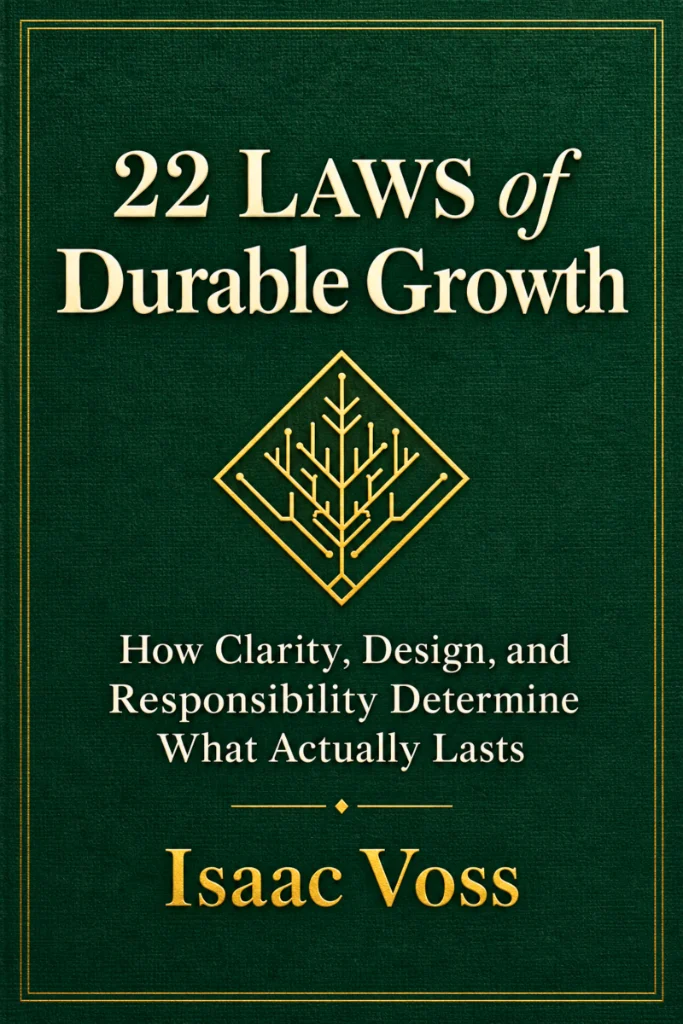
22 Laws of Durable Growth
How Clarity, Design, and Responsibility Determine What Actually Lasts
by Isaac Voss
Growth is easy to initiate. Durability is rare: twenty-two principles show how clarity, design, and responsibility help organizations last under pressure.
Growth can make a company bigger without making it stronger. When new opportunities, people, tools, and commitments arrive faster than a business can absorb them, small ambiguities turn into costly failure points.
In 22 Laws of Durable Growth, Isaac Voss examines the structural decisions that determine whether an organization can endure the pressures created by its own success. The book explores clarity before scale, responsibility before delegation, systems that tolerate load, decision-making under friction, and the value of leadership discipline over perpetual urgency.
Rather than treating durability as resistance to change, the framework asks leaders to design for change. It connects communication, ownership, repeatable processes, and sound judgment to the long-run performance of a growing enterprise.
The message is simple but demanding: momentum is not the same as infrastructure, and visibility is not the same as accountability. Growth that holds requires deliberate structure.
Twenty-two laws in five sections, as published in the First Edition. Each law opens with the principle it names.
Section I — Foundations
Section II — Systems
Section III — People & Leadership
Section IV — Growth & Risk
Section V — The Long View
Five core themes
Founders, presidents, managers, operators, and owners of growing organizations; especially leaders of multi-location and service businesses who need stronger systems while expanding. Also relevant to readers assessing technology adoption and the operating discipline needed to use AI responsibly.
- Founders scaling responsibly
- Operators building multi-layered systems
- Leaders navigating technological acceleration
- Owners of multi-location and service businesses
- Decision-makers adopting AI who need operating discipline first
Book details
- Author
- Isaac Voss
- Publisher
- ScrollBearer Press
- Edition
- First Edition · 2026
- Format
- Hardcover
- ISBN-13
- 9798247536246
- Structure
- 22 laws in five sections